Key Takeaways
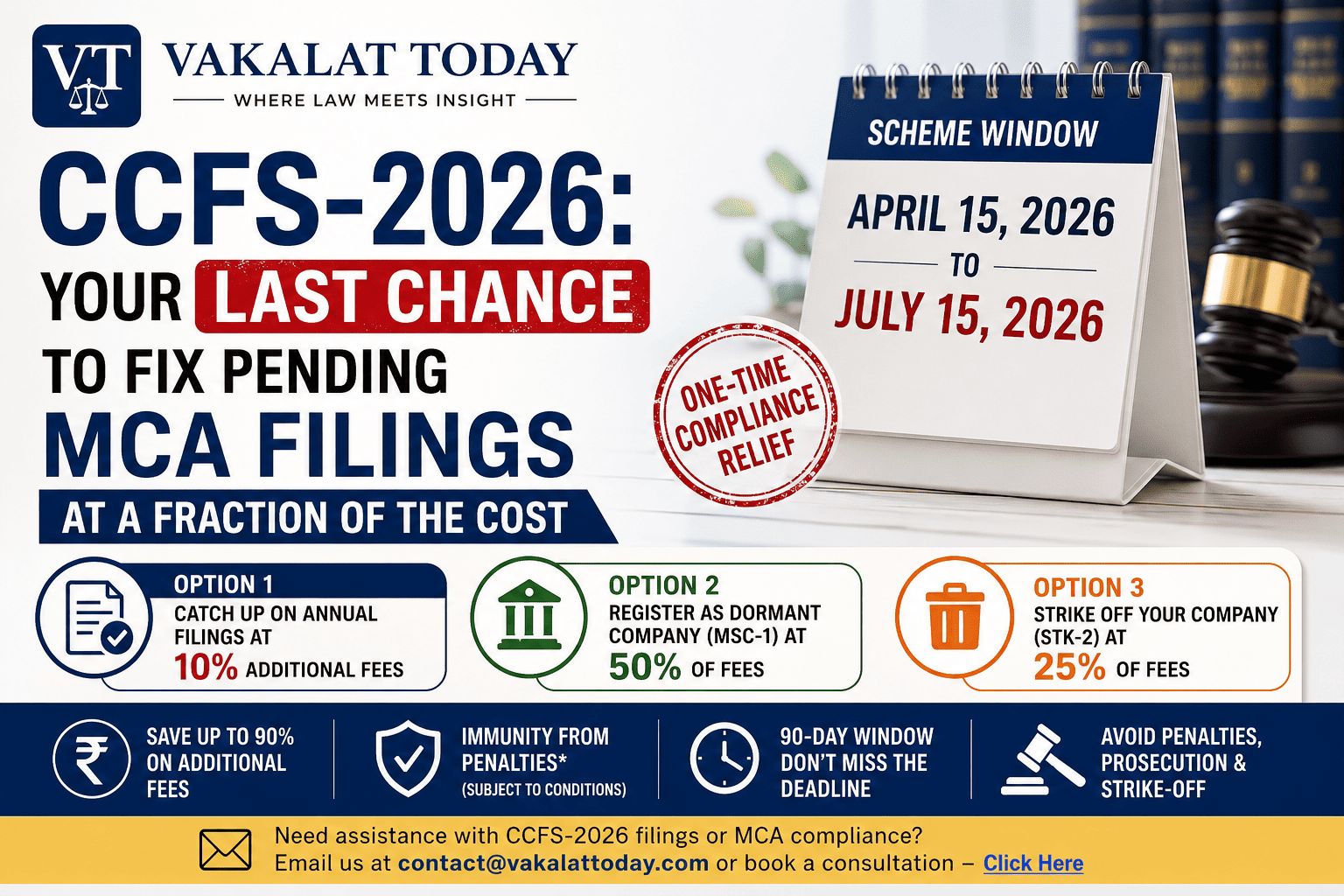
- MCA has launched CCFS-2026, a one-time compliance relief scheme running from April 15 to July 15, 2026.
- Companies can file overdue annual returns (MGT-7/MGT-7A) and financial statements (AOC-4) by paying only 10% of the accumulated additional fees.
- Inactive companies can opt for dormant status (MSC-1) at 50% of normal fees, or apply for strike-off (STK-2) at just 25% of fees.
- The scheme covers filings under both the Companies Act, 2013 and the Companies Act, 1956.
- Companies not filing during this window face penalties, prosecution, and ROC strike-off action post-July 2026.
- MSMEs, startups, OPCs, and small private companies stand to benefit the most from this relief.
This article breaks down every key aspect of CCFS-2026 and what your company must do before the July 15 deadline.
What Is CCFS-2026 and Why Did MCA Introduce It?
India now has over 20 lakh registered companies, yet a significant portion remain non-compliant with basic annual filing obligations. The Ministry of Corporate Affairs (MCA) introduced the Companies Compliance Facilitation Scheme, 2026 (CCFS-2026) to address this growing backlog and give defaulting companies a genuine path to regularisation.
Under Sections 92 and 137 of the Companies Act, 2013, every company must file its Annual Return (MGT-7 or MGT-7A) and Financial Statements (AOC-4 and variants) each year. Missing these deadlines triggers additional fees under Section 403 of Rs. 100 per day with no upper limit. For companies that have missed filings for multiple years, these penalties can run into lakhs.
CCFS-2026 removes that financial barrier. For a limited 90-day window, companies can clear their entire compliance backlog, exit cleanly, or mothball inactive entities at a dramatically reduced cost.
Scheme Window: April 15 to July 15, 2026
The scheme is open for exactly three months:
Start Date: April 15, 2026 | End Date: July 15, 2026
This is a hard deadline. MCA has not signalled any extension, and post-scheme enforcement is expected to be significantly more stringent. Companies that miss this window will face full additional fees, possible prosecution, and ROC-initiated strike-off.
Three Options Under CCFS-2026: Choose What Fits Your Company
Option 1: Catch Up on Annual Filings at 10% Additional Fees
This is the primary relief for active companies with a backlog of annual return and financial statement filings. Under CCFS-2026, companies can file all overdue forms by paying just 10% of the total additional fees that would otherwise be due under Section 403.
For a company that has missed three years of filings, this could mean savings of tens of thousands of rupees. The reduced fee applies to the total accrued penalty, not just the most recent year.
Option 2: Register as a Dormant Company (MSC-1) at 50% Fees
If your company has been inactive but you want to preserve the legal entity, applying for dormant status under Section 455 of the Companies Act, 2013 is the smart move. Under this scheme, the MSC-1 form can be filed at 50% of the normal prescribed fees.
A dormant company has minimal compliance obligations going forward, making it ideal for entities holding assets, IP, or trade names without active business operations.
Option 3: Strike Off Your Company (STK-2) at 25% Fees
For companies that no longer have any business purpose, the scheme offers a clean exit. File Form STK-2 to apply for removal of the company name from the MCA register at only 25% of the prescribed filing fees.
This is especially relevant for promoters of shell companies or dormant ventures who have been deferring closure due to the compliance cost and procedural complexity.
Which Forms Are Covered Under the Scheme?
CCFS-2026 covers a wide range of pending filings across both company law regimes:
Under the Companies Act, 2013
- MGT-7 / MGT-7A – Annual Return
- AOC-4 and variants – Financial Statements
- ADT-1 – Auditor Appointment
- FC-3 and FC-4 – Foreign Company filings
Under the Companies Act, 1956
- Form 20B and 21A
- Form 23AC and 23ACA
- Form 66, 23B, and related forms
Who Can Apply – and Who Cannot?
The scheme is open to all registered companies in India, with the following exclusions:
- Companies under a final strike-off notice under Section 248
- Companies that have already applied for strike-off
- Companies that have already applied for dormant status
- Companies dissolved under a scheme of amalgamation
- Vanishing companies
If your company does not fall into any of the above categories, you are eligible to benefit from CCFS-2026.
Immunity from Penalty: What Protection Does the Scheme Offer?
For Annual Filings (Sections 92 and 137)
If filings are made before any notice is issued by an adjudicating officer, or within 30 days of such notice, no penalty will be levied under these sections. If adjudication has already been completed before the filing, the penalty remains payable – but the additional fee relief still applies.
For Other Covered Forms
Where forms are filed under this scheme and no prior notice or prosecution has been initiated, companies receive immunity from future penal action related to those filings. This is a meaningful protection for companies wishing to regularise and move forward without regulatory risk.
What Happens After the Scheme Closes on July 15, 2026?
MCA has made clear that stricter enforcement will follow the close of the scheme. Companies that remain non-compliant after July 15, 2026 can expect:
- Significant financial penalties
- Prosecution of directors and key managerial personnel
- ROC-initiated compulsory strike-off action
The scheme is explicitly positioned as a final amnesty before tighter enforcement. Treating it as optional is a significant risk for any company with a compliance backlog.
Who Should Act Immediately?
CCFS-2026 is particularly valuable for:
- MSMEs that have accumulated multi-year filing arrears
- Startups that never completed their annual compliance cycles
- One Person Companies (OPCs) with lapses in filings
- Small private companies where promoters were unaware of ongoing obligations
- Any company where the cost of penalty had made compliance seem economically unviable
Conclusion: A Narrow Window, a Major Opportunity
CCFS-2026 is one of the most substantial compliance relief initiatives MCA has introduced in recent years. For the vast majority of defaulting companies, the 10% additional fee concession makes it economically rational to regularise immediately. The alternatives – ongoing penalties, prosecution risk, and forced strike-off – are far more costly.
The window is 90 days. The benefits are real. The post-scheme consequences are serious. If your company has pending MCA filings, now is the time to act.
Need Legal Assistance with MCA Compliance?
If you require assistance with CCFS-2026 filings, MCA compliance, or any other corporate legal services mentioned in this article, feel free to email us at contact@vakalattoday.com. If you have any legal queries or require legal assistance, you can book a consultation directly: Click Here. Schedule a 30-minute session at your convenience.
This article is intended to provide a general guide to the subject matter and does not constitute legal advice. Specialist legal advice should be sought for your specific circumstances.

Meet Siddhant Jain — a lawyer who thrives in the dynamic world of Business & Commercial Law, Private Client Practice, and Maritime Matters. For him, boardrooms are battlefields, mergers are puzzles, and corporate jargon is a second language. Whether it’s navigating the maze of company law, tackling securities regulations, steering businesses through the stormy seas of bankruptcy and insolvency, or handling complex maritime disputes, Siddhant has done it all.
Beyond the corporate hustle, Siddhant also works closely with private clients — advising on wills, Trust, family settlements, agreements, and bespoke legal strategies to safeguard both business and personal interests.
From drafting intricate legal opinions on mergers to guiding company closures, and from advising shipping stakeholders to assisting families in succession planning, his practice spans a diverse legal spectrum. And when he’s not solving legal riddles, Siddhant shares his insights through newsletters and publications — because why should only his clients benefit from all that knowledge?
If you’re looking for someone who can untangle the knots of business law, safeguard your personal matters, or help you sail through maritime complexities (with a touch of humor along the way), Siddhant’s your guy.
📩 Reach him at siddhantjain2403@gmail.com