
The article is written by Vedant Jain, a graduate of Government Law College, Mumbai.
Introduction :-
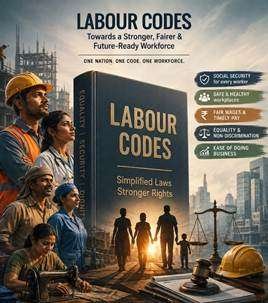
A sweeping labour law reforms have been brought in India through the four Labour Codes, changing the legal landscape which governs the workplaces, workmen and its relations with employers. The new laws, which fall within the ambit of Concurrent list, have been formulated by the Central government, whereas, the rules under the said codes are yet to be notified by the State governments of respective states. With the reforms taking effect on 21st November, after around 5 years of getting notified in gazette, the existing 29 laws would cease to operate and the entire administration around labour laws would be covered by four codes which form the constituents of the rejig. The new laws are going to affect around 50 Cr. of workers employed in organized and unorganized sector. It has been envisaged that the four codes, namely, Code on Wages, 2019, the Industrial Relations Code, 2020, the Code on Social Security, 2020, and the Occupational Safety, Health and Working Conditions (OSH) Code, 2020, would benefit all the stakeholders at all levels. The government has backed the current reforms by claiming that 90% of workers are employed in unorganized sector and that such workers were not able to receive benefits of government schemes and policies which were meant for them. The existing laws and administration were divided into 29 laws making it complex for workers to avail the benefits. The new laws would provide better working conditions and social securities to workmen while making it easier for workers to reach out for benefits. The reforms are also envisaged to increase ease of doing business and enhance the total outputs of industries. While the actual results are awaited, it is important to get acquainted with new realities and calibrate the existing industrial models to meet the requirements of the new laws.
Changes :-
- Code on Wages, 2019 – Code on Wages, 2019 amalgamates 4 laws and liberalized the concept of Wages in India. Firstly, the definition of Wages has been redefined and has been kept uniform in all the codes. The new definition, defined under Section 2(y) and 3, would have implications over calculations of Provident funds contributions, Employee state Insurance, gratuity and other contributions or schemes which are calculated or derived from the value of wages. The definition of “employee” has also been revised to cover all workers without excluding high salaried persons. A new provision pertaining to pan-India minimum wage has been introduced. According to concept of “National Floor Wage” (defined under Section 9), a minimum wage fixed by Central government would be followed by State government for formulating their minimum wages. No State government can set minimum wage below the rate fixed by Central government. Also, the code has imposed obligations on employers to provide equal wages to both male and female employees. Section 2(y) provides that parity in wages of both genders for equal work or similar work has to be maintained. Also, one of the provision of the code states that payment of wages should be made within two working days from the date of resignation taking effect. Further, it is also required for the employers to pay bonus to employees at minimum of 8.33% of the annual wages. However, the eligibility of employee based upon the certain threshold of salary, would be notified by government later. It is also noteworthy that, under the new code, payment of wages in online mode has been recognized.

- Code on Social Security, 2020 – The code amalgamates 9 existing laws. The code has introduced several new concepts and definitions. Under Section 2(2) it has brought the concept of “Aggregators”. Aggregator means the intermediary platform which acts as a link between buyer and seller. It provides services by acting as an intermediary. Online delivery apps like Zomato, Amazon could be an apt example and the delivery boys could be termed as platform workers. The code provides for Central government to notify social security schemes for such gig workers or platform workers. Alongside, the Code has also defined both “gig workers” and “platform workers”. The concept of fixed term employment is also introduced along-with the provisions to provide equal hours of work, wages, allowances and benefits to fixed term employees, which permanent employees are receiving. The fixed term employee shall also receive gratuity even though his employment term is less than 5 years. The code also proposes to set up National Social Security Board (NSSB) which would recommend suitable social security schemes to Central government. The code, under Section 3, mandates every establishment upon which the code applies, to register itself electronically. However, if it is already registered under any act previously, it would be deemed to be registered. The Code also provides for voluntary Provident fund and Employee State Insurance coverage. Employers can voluntarily apply for PF and ESI if majority of employees are in favour of it.
- Occupational Safety, Health and Working Conditions (OSH) Code, 2020- The code amalgamates 13 existing legislations and incorporated provisions regulating safety standards to be maintained at the workplaces. The code has provided definition of term “establishment” which replaces the varying definitions of different establishments under previous acts. Any place in which 10 or more workers are employed are covered under the definition of “establishment”. The definitions of “Workers” and “Contract labour” has also underwent minor changes and so is the case with definition of “Inter-state migrant workers” .The definition of Inter-state migrant workers has been widened and became inclusive. A new provision has been introduced under Section 2(p), defining the term “Core activities of an establishment”. The code has also brought unified provisions for “Daily working hours” and “Overtime wages”. The provisions states that the workers should not be asked for work more than 8 hours a day and any overtime work done by the employee should be compensated with twice the amount of wage applicable to it. The employer is also mandated to give at least one holiday in a week. The provisions related to annual leaves states that the employer should grant atleast 1 day of paid leave for every 20 days of attendance by the worker (applicable to workers who work more than 180 days a year). The holidays lying between the leave taken by employee should not be calculated as leaves and un-availed leaves upto 30 can be carried over to next year. There is also a new provision related to “Annual Leave Enchashment”. Workers who have un-availed leaves at the end of year, can encash such leaves, even if the leaves exceeds 30 days. The provision is also available for the resigning workers or workers who have been removed from office or who has died during the course. One significant development made by the provisions of the code is that women can even work during 7 pm-6 am which previously was not allowed under Factories Act, 1948. However, the employer has to comply with the conditions specified under respective state legislations applicable for employment of women in night shift. There is another provision in the act which provides that the employer employing more than 10 migrant workers, would have to provide travel allowance to the employees for the journeys made by them from or towards its native place. Finally, the code has also extended the duties of employers for the maintenance of safe and healthy working atmosphere, free of all hazards.

- Industrial Relations Code, 2020 :- Industrial Relations Code, 2020 amalgamates 3 existing laws and provided swift dispute resolution mechanisms for the disputes emanating between the employer and employees during the course of employment. Firstly, the formation of Grievance Redressal Committee has been mandated for every establishment with more than 20 workers. In the previous laws the formation of GRC is not mandatory for establishments which had an established grievance redressal mechanism. The inclusion of women is a notable development. The provisions have enacted some new concepts like Negotiating Unions, Negotiating Council, Worker Reskilling Fund & Disciplinary inquiry timeline. Negotiating union are trade union of workers supposed to negotiate with employers on the matters notified by relevant government. Negotiating Councils are councils which are established from the representatives of registered unions for negotiating with employer. Such councils are made when no trade union has support of at least 51% of workers which is required to recognize the sunion as a negotiator. However, the trade unions which have representation in council should have at least 20% support of total workers in the establishment. Worker reskilling fund, as has been defined under Section 83, would be constituted by the appropriate government. Such fund would receive contribution from employer in case the employer retrench any employee. Contributions in such case would be equivalent to 15 days’ last drawn wages of retrenched worker. Further, Disciplinary Inquiry Timeline means the timeline which is to be followed in cases when an employee is suspended due to misconduct. The rule states that investigation shall be completed within 90 days from the date of dismissal and the employer shall also pay subsistence allowance to the dismissed worker during the period of investigation. Finally, Section 30 deals with the “Standing Orders” which has to be adopted by the employers in case of establishments having minimum 300 workers in the preceding 12 months. The draft standing orders can be replicated from the Model Standing Orders notified by the Central government or if the employer wishes it can adopt the Model Standing Order after making any changes in it. This exercise, however, needs to be completed within 6 months from the date the code is enforced or 6 months from the date the employment of establishments reaches 300 employees. If there is any changes made in the Model Standing Orders, the draft has to be certified form the nodal authority (to be notified by Central government). Within 60 days from the application of certification of Model Standing Order, the authority should certify the draft failing to which the draft would be deemed certified. If in case the employer adopts Model Standing Order, the same would be deemed certified and employer would have to inform about it to certifying officer. A group of employers are also permitted to jointly submit common Draft Standing Orders for certification.
Conclusion :-
The four labour codes have significantly impacted the governance of workplaces and the relations between employee and employer. The codes have come as a shot in the arm as the establishments and businesses in India are growing at the maximum pace, with their output being multiplied in the recent years. The reforms have the potential to liberalize the working atmosphere, making it conducive for the workers to get maximum benefits which would in turn scale up overall output. The complexities in the laws were making the operation of schemes a difficult task, but now, with the enforcement of codes, the policies meant for the workers can be utilized in a much easier way. A big shift in the provisions related to minimum wages, social security schemes, and employers obligations would result in overall wellbeing of workers specially women employees who have long been denied of the rights at workplace.
Now, since the codes have already become operational, it is only the practical application of those laws that would determine if the intended aims of the codes would bear fruits. India has undergone times when the women had been struggling at workplaces due to emerging cases of sexual harassments and have also seen the phase when migrant workers were struggling to find a means to travel back to their native place during COVID. The labour reforms have been long called for, which has been delivered by the four codes. The results would depend upon the enforcement of laws.

Want to publish on Vakalat Today? Email us at contact@vakalattoday.com and our team will reach out to you.