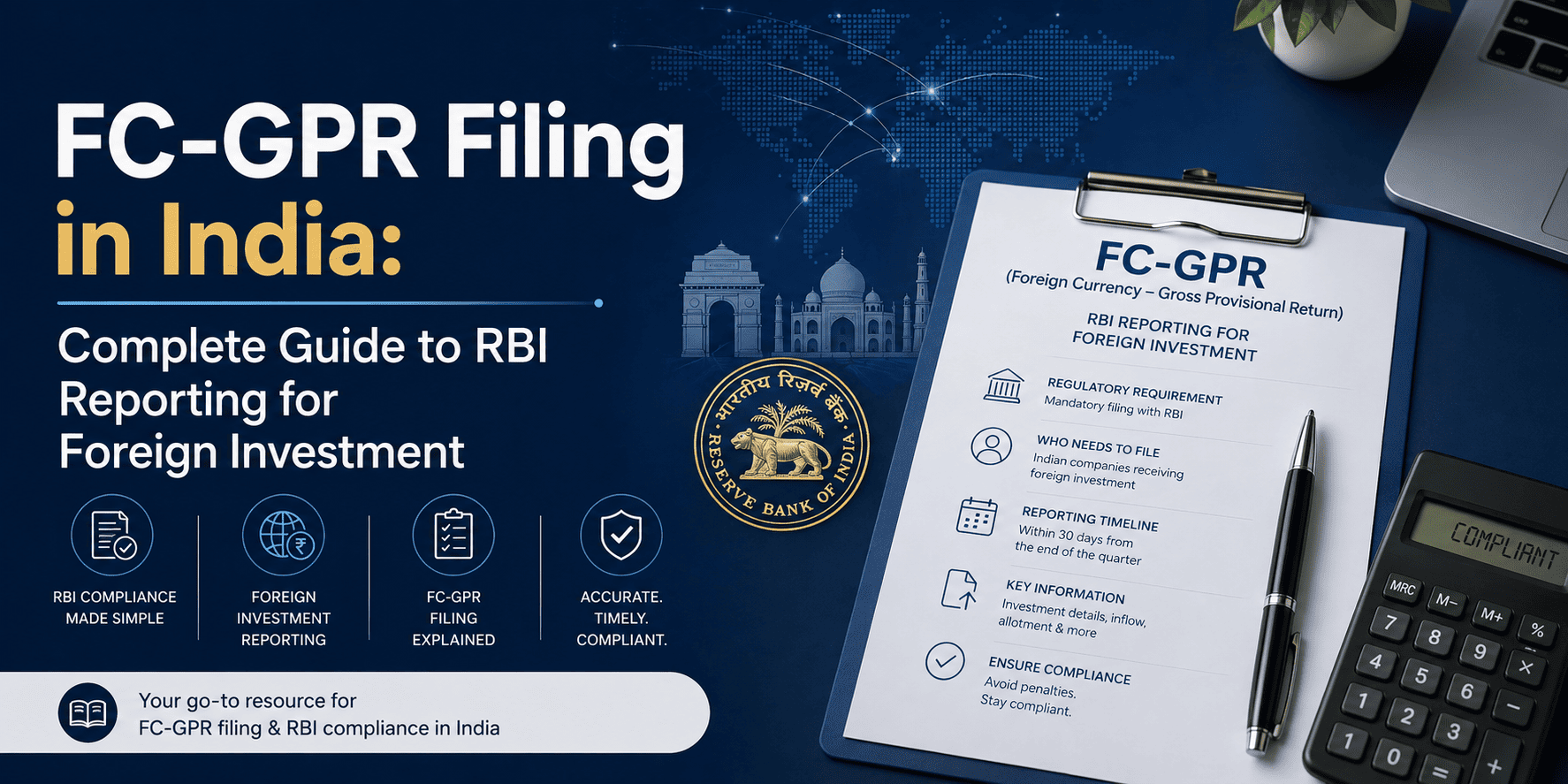
The article is written by Adv. Siddhant Jain. As a corporate lawyer, I have closely advised private companies, startups, investors, and founders on navigating the complex foreign investment and exchange control framework in India. FC-GPR reporting is not merely a procedural formality—it is the foundation of a company’s foreign investment compliance record with the Reserve Bank of India, and errors or delays can have lasting regulatory consequences. In this guide, I break down exactly what FC-GPR is, when it must be filed, what documents are required, and how to avoid the common mistakes that lead to rejection or late submission fees. Whether you are dealing with a fresh allotment of equity shares to an overseas investor, a CCPS conversion, or a first-time FIRMS portal registration, this guide is designed to give you the clarity and practical steps you need to get it right.
Key Takeaway
- FC-GPR (Foreign Currency – Gross Provisional Return) is the statutory form Indian companies must file with RBI every time they issue capital instruments to a foreign investor.
- The filing deadline is 30 days from the date of allotment – not from receipt of funds.
- All details in the form must exactly match the FIRC, KYC report, valuation certificate, board resolution, and share subscription documents to avoid rejection.
- Late filing must be regularised by paying a Late Submission Fee (LSF); failure to do so can trigger penal proceedings under Section 13 of FEMA, 1999.
- FC-GPR is distinct from FC-TRS (transfer of shares) and FLA (annual return) – each serves a different purpose under FEMA.
This guide covers the complete FC-GPR filing process, from registration on the RBI FIRMS portal to avoiding common rejection errors.
Introduction: Why FC-GPR Matters for Indian Companies Receiving Foreign Investment
If your Indian company has received foreign investment and issued equity shares or other capital instruments to an overseas investor, you are legally required to report that transaction to the Reserve Bank of India. The vehicle for that report is Form FC-GPR.
FC-GPR compliance sits at the intersection of FEMA, the Companies Act, 2013, and RBI’s evolving regulatory framework. Getting it right – on time and with accurate documentation – is not optional. Non-compliance can result in late fees, regulatory scrutiny, or penal action under FEMA.
This guide breaks down everything you need to know: what FC-GPR is, when it must be filed, what documents are required, how to navigate the FIRMS portal, and how to avoid the most common mistakes.
What Is Form FC-GPR?
Form FC-GPR – Foreign Currency Gross Provisional Return – is the statutory reporting form used whenever an Indian company issues capital instruments to a person resident outside India.
The obligation arises under two key pieces of legislation: the Foreign Exchange Management Act, 1999 (FEMA) and the Foreign Exchange Management (Non-Debt Instruments) Rules, 2019. Every time fresh equity shares or other eligible capital instruments are allotted to a foreign investor, the Indian company must report the transaction to RBI through its Authorised Dealer (AD) bank via the FIRMS portal.
In practical terms, FC-GPR records the inflow of foreign direct investment and updates the company’s foreign shareholding position in RBI’s database.
When Is FC-GPR Filing Required?
FC-GPR must be filed whenever capital instruments are issued to a person resident outside India. The instruments covered include:
- Equity shares
- Compulsory Convertible Preference Shares (CCPS)
- Compulsory Convertible Debentures (CCDs)
- Share warrants (upon conversion into equity shares)
- Convertible notes (upon conversion into equity shares)
- Sweat equity shares
- Equity shares allotted on exercise of ESOPs
- Bonus shares allotted to persons resident outside India
- Rights issue shares allotted to persons resident outside India
A few special rules apply to certain instruments:
Convertible notes issued by startups are first reported in Form CN within 30 days of issue. If and when the note converts into equity shares, a separate FC-GPR must be filed within 30 days of allotment.
ESOPs granted to non-residents are reported in Form ESOP within 30 days of grant. Once the ESOP is exercised and shares are allotted, FC-GPR must be filed within 30 days of that allotment.
FC-GPR Filing Timeline: Key Deadlines You Cannot Miss
The reporting timeline under FEMA operates sequentially and is non-negotiable:
| Event | Timeline |
| Foreign funds received | Day 0 |
| Capital instruments must be allotted | Within 60 days from receipt of funds |
| FC-GPR filing deadline | Within 30 days from date of allotment |
The 30-day FC-GPR deadline runs from the date of allotment, not from the date the money was received. This distinction matters: even if funds are received early, the clock on FC-GPR starts only once shares are formally allotted.
Under the Companies Act, 2013, shares must be allotted within 60 days from receipt of application money. If allotment does not happen within this window, the company must refund the funds within 15 days of the expiry of the 60-day period. Failure to refund within that additional 15 days means the amount is treated as a deposit under Rule 2(1)(c) of the Companies (Acceptance of Deposits) Rules, 2014 – a classification that carries its own compliance obligations.
Documents Required for FC-GPR Filing
Assembling the right documents before you begin is essential. Inconsistencies between documents are the primary reason FC-GPR filings are queried or rejected by the AD bank. The standard set of documents includes:
- Foreign Inward Remittance Certificate (FIRC)
- KYC report of the foreign investor (issued by the AD bank)
- Board resolution for allotment of securities and list of allottees
- Valuation certificate (from a practicing CA or SEBI-registered merchant banker)
- Company Secretary certificate in RBI format
- Declaration by the authorised representative of the Indian company
- Memorandum of Association (if required based on nature of investment)
- Letter of debit authorisation
- Declaration of conversion of CCPS (if applicable)
- Written explanation for any delay in submission (if applicable)
Every figure and investor detail across these documents must be internally consistent. Reconcile amounts, investor names, addresses, and share numbers before filing.
How to File FC-GPR on the RBI FIRMS Portal: Step-by-Step
FC-GPR is filed online through the RBI FIRMS portal. The process requires prior registration before any return can be submitted. Here is how it works end to end.
Step 1: Create an Entity User on the FIRMS Portal
Before anything else, the company must register as an Entity User on the FIRMS portal. During registration you will need to provide the company’s CIN and details, registered email and mobile number, PAN, and an authorisation letter on company letterhead.
The authorisation letter must be addressed to the correct RBI Regional Office (Foreign Exchange Department). Getting the regional office address wrong is a frequent and avoidable cause of rejection. Once submitted, the RBI Regional Office reviews the application and, if approved, issues login credentials to the registered email.
Step 2: Register the Entity and Create a Business User
After logging in as Entity User, you must register the company under Entity Master and then create a Business User account – the account that will actually submit FC-GPR.
During Entity Master registration, enter the company’s CIN and address, NIC code for primary business activity, and paid-up capital on a fully diluted basis. If no prior foreign investment exists, enter zero in the relevant fields. Note that the portal has no draft-save functionality – compile all required information before you begin.
For the Business User, fill in the authorised person’s details, select the relevant AD bank, and upload a Business User Authorisation Letter. Credentials are typically issued within a few working days of approval.
Step 3: Initiate a Fresh FC-GPR Return
Once the Business User is activated, log into the FIRMS portal, navigate to the Single Master Form, select FC-GPR, and click ‘Add New Return.’ If you are revising an existing filing, select the relevant previous return number.
Before proceeding, verify the sectoral cap and entry route applicable to your investment. If the foreign investment requires government approval, have the approval copy ready to upload.
Step 4: Fill in Basic Transaction Details
Specify the nature of the issue (subscription, conversion, etc.) and confirm whether this is a fresh filing or linked to a prior one. If foreign shareholding was previously declared in Entity Master, select the appropriate option.
Step 5: Enter Foreign Investor Details
Only persons resident outside India should be entered in this section – do not include Indian shareholders. For each foreign investor, provide general details (name, address, town, state) and particulars of the issue (type of instrument, number of securities, conversion ratio, face value, premium).
The investor’s name and address must match the FIRC and KYC exactly. Even minor spelling discrepancies or formatting differences between the form and the bank documents will result in rejection.
Step 6: Enter Remittance Details
This section requires the date of remittance (the date funds were credited to your bank account), the amount received in INR as per the FIRC, the bank name and IFSC of the receiving bank, and the mode of receipt (banking channel, NRE account, etc.).
The amounts entered here must match the share subscription agreement, FIRC, and bank KYC precisely. If excess funds were received, ensure any refund or adjustment is FEMA-compliant before filing.
Step 7: Enter Valuation Details
Disclose the fair value of shares in INR and attach the valuation certificate. The issue price must not fall below the fair value determined in accordance with FEMA pricing guidelines.
Step 8: Upload Supporting Documents
Upload all required documents in the prescribed formats. Every document must be signed, dated, and consistent with the details entered in the form. Include the contact details of the filing person in the supporting documents, as the AD bank may seek clarification. Review all declarations carefully – if a clause is not applicable, strike it out rather than deleting it.
Step 9: Review and Submit
Before clicking submit, recheck share numbers, remittance date, issue price, and investor details against the bank documents. Confirm all mandatory attachments are in place. Once submitted, the AD bank reviews and approves the form. Approval marks completion of the FC-GPR reporting obligation.
What Is the Penalty for Late FC-GPR Filing?
Missing the 30-day deadline triggers a Late Submission Fee (LSF) framework prescribed by RBI (Circular RBI/2022-23/122). The LSF is calculated as follows:
LSF = INR 7,500 + (0.025% x A x n) | A = amount involved in delayed reporting | n = years of delay (rounded upward to nearest month, expressed to two decimal places)
Additional conditions to be aware of:
- The maximum LSF payable is capped at 100% of the amount involved (A), rounded upward to the nearest hundred.
- The LSF option is available only up to three years from the original filing due date.
- If an LSF advice is issued and not paid within 30 days, it becomes void. Any fresh application thereafter uses the new application date as the reference point for calculating the delay period.
- If neither the return is filed on time nor the delay regularised through LSF, the matter may be referred for penal action under Section 13 of FEMA, 1999.
Common FC-GPR Filing Mistakes and How to Avoid Them
Most rejections and queries from the AD bank stem from a handful of recurring issues. Being aware of them before you start will save significant time.
- Non-compliant valuation certificate: The valuation must follow FEMA pricing guidelines and be issued by a practicing Chartered Accountant or SEBI-registered merchant banker. Certificates that do not meet these standards are rejected.
- Mismatched investor KYC: The investor’s name and details in the FC-GPR form must exactly match the KYC issued by the AD bank. Even minor inconsistencies – a middle name included in one place and not another, for example – can cause rejection.
- Insufficient coordination with the AD bank: FC-GPR filings are routed through the AD bank. If the bank is not informed in advance, or supporting documents are unclear, the bank will raise queries or reject the form. Engage your AD bank early.
- Incorrect instrument classification: Misreporting CCPS, CCDs, convertible notes, or equity shares can lead to rejection or downstream compliance complications.
- Incomplete or improperly executed declarations: Missing board resolutions, unsigned certificates, unstamped authorisation letters, or altered declaration formats are common grounds for technical rejection.
Best practice: Reconcile the share subscription agreement, valuation report, FIRC, KYC report, and cap table with each other before beginning the filing.
FC-GPR vs FC-TRS vs FLA: Understanding the Differences
FC-GPR is often confused with two other RBI forms that also relate to foreign investment. Here is how they differ.
FC-GPR vs FC-TRS
FC-GPR applies to the fresh issue of capital instruments to a foreign investor. FC-TRS applies when existing shares are transferred between a resident and a person resident outside India. The two forms cover different transaction types and have different filing deadlines.
| Basis | FC-GPR | FC-TRS |
| Nature | Issue of new capital instruments | Transfer of existing shares |
| Trigger | Allotment to a person resident outside India | Transfer between a resident and a non-resident |
| Filing Timeline | 30 days from allotment | 60 days from consideration or transfer/remittance (whichever is earlier) |
FC-GPR vs FLA
The Foreign Liabilities and Assets (FLA) return is an annual filing that captures a company’s total outstanding foreign liabilities and overseas investments as of 31 March each year. Unlike FC-GPR – which is triggered by each allotment event – FLA is a standing annual obligation for any company that has received foreign investment.
| Basis | FC-GPR | FLA |
| Nature | Transaction-specific filing | Annual return |
| Trigger | Allotment of capital instruments to a non-resident | End of financial year (31 March) |
| Deadline | Within 30 days from allotment | On or before 15 July each year |
| Purpose | Report new foreign capital inflow | Report total outstanding FDI and ODI position |
| Portal | FIRMS Portal (Single Master Form) | FLAIR Portal |
Companies that receive foreign investment will typically have obligations under both FC-GPR and FLA. These are not alternatives – they serve different purposes in RBI’s foreign investment reporting framework.
FAQs on FC-GPR Filing
Is there a filing fee for FC-GPR?
No filing fee is payable provided the form is submitted within the prescribed 30-day timeline.
When exactly does the 30-day filing window begin?
The 30 days runs from the date of allotment of capital instruments, not from the date of receipt of funds. Even if funds were received well in advance, the FC-GPR clock starts on allotment day.
What if I miss the 30-day deadline?
You must regularise the delay by paying the applicable LSF through RBI’s prescribed process. The LSF option remains available for up to three years from the original deadline. Beyond that, or if LSF is not paid, the matter becomes liable for penal action under FEMA.
Need Help with FC-GPR Filing?
If you require assistance with FC-GPR filing, FEMA compliance, or any other foreign investment regulatory matters, feel free to email us at contact@vakalattoday.com. If you have any legal queries or require legal assistance, you can book a consultation directly:
Click Here to schedule a 30-minute session at your convenience.
This article is intended to provide a general guide to the subject matter and does not constitute legal advice. Specialist legal advice should be sought for your specific circumstances.

Meet Siddhant Jain — a lawyer who thrives in the dynamic world of Business & Commercial Law, Private Client Practice, and Maritime Matters. For him, boardrooms are battlefields, mergers are puzzles, and corporate jargon is a second language. Whether it’s navigating the maze of company law, tackling securities regulations, steering businesses through the stormy seas of bankruptcy and insolvency, or handling complex maritime disputes, Siddhant has done it all.
Beyond the corporate hustle, Siddhant also works closely with private clients — advising on wills, Trust, family settlements, agreements, and bespoke legal strategies to safeguard both business and personal interests.
From drafting intricate legal opinions on mergers to guiding company closures, and from advising shipping stakeholders to assisting families in succession planning, his practice spans a diverse legal spectrum. And when he’s not solving legal riddles, Siddhant shares his insights through newsletters and publications — because why should only his clients benefit from all that knowledge?
If you’re looking for someone who can untangle the knots of business law, safeguard your personal matters, or help you sail through maritime complexities (with a touch of humor along the way), Siddhant’s your guy.
📩 Reach him at siddhantjain2403@gmail.com